What we don't ask for on EMeetE, and why
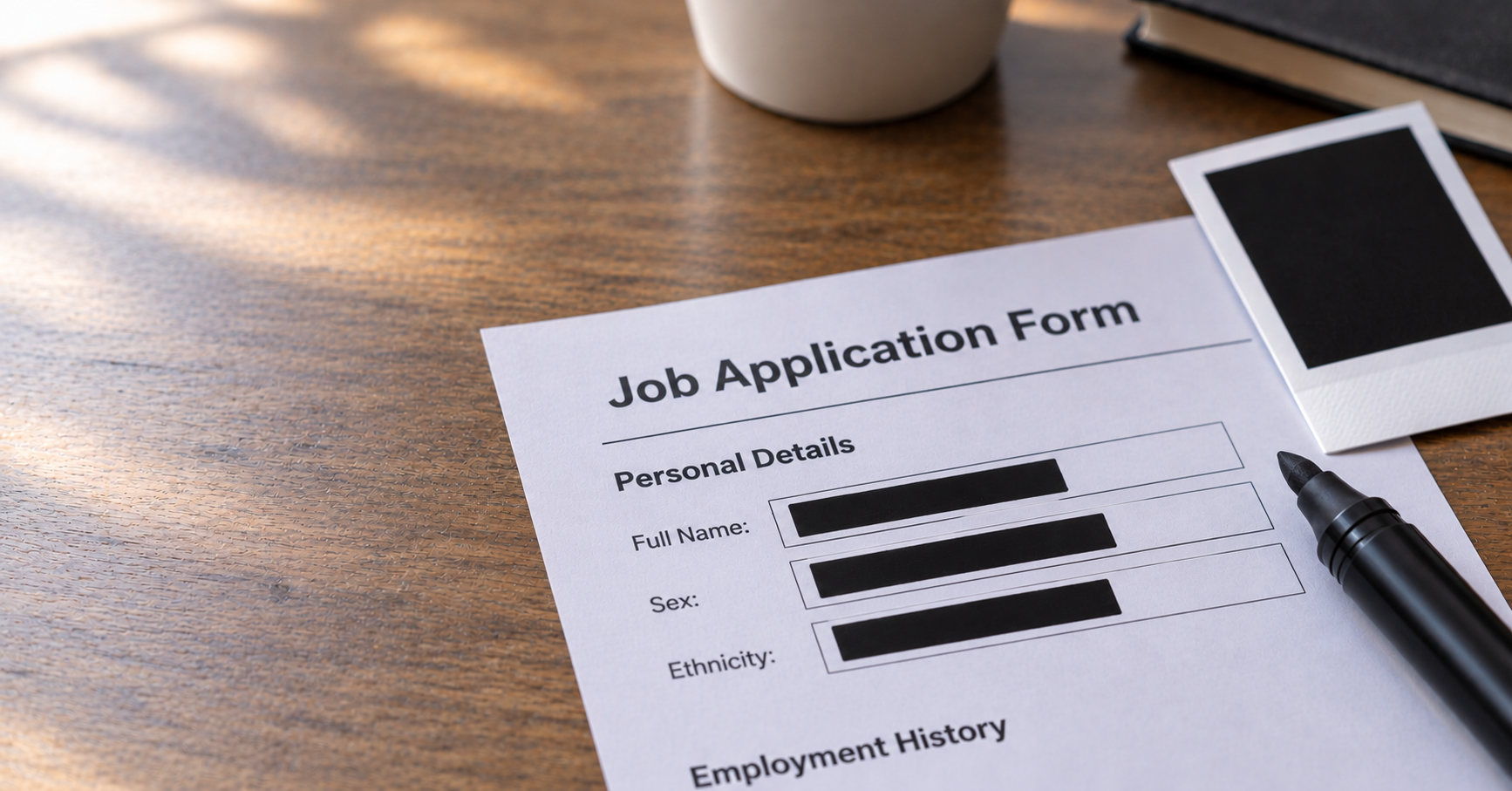
Plenty of hiring forms ask for your date of birth, your gender, sometimes your ethnicity, and a photo. EMeetE asks for none of it.
There's no age field in your profile. There's no gender or race field. There's no place to upload a photo. None of it is picked up when your CV is read, and none of it is passed on to employers. We left it out on purpose.
Why leave it out?
The simplest way to stop information being used against someone is never to collect it.
It's not a theoretical problem. Employment lawyers from Simpson Grierson, quoted by HRD New Zealand, warn that if a screening tool filters out people on protected characteristics, that can amount to unlawful discrimination "even when nobody meant it", and that when a model learns from biased history, "the model will replicate that at scale".
In the US, Derek Mobley has sued the software company Workday, alleging its screening tools rejected him and others on the basis of race, age and disability. In 2025 the court allowed the age claim to proceed as a collective action. In March 2026, Judge Rita Lin let disparate-impact age claims from job applicants go ahead, and the case was still ongoing in mid-2026, with Workday seeking an appeal on one ruling. Nothing has been proven. Workday says the claims are false, and that its tools don't make hiring decisions and are designed with human oversight. His lawyer told Australia's 60 Minutes that around 15,000 people are part of the age claim. The point is that this is now being tested in court.
At home, New Zealand media veteran Jacqueline Freeman, who founded the 58 & Unapologetic movement, has been telling recruiters to stop putting upper age limits on job adverts and not to screen people out "just because of the year they were born".
RNZ’s Anya Fielding has also been talking to older applicants. Lisa Dudley, 57, with 40 years in customer service, said she had been advised to “dumb down” her CV so she didn’t look overqualified. Melinda Netto, 55, said she had applied for 100 jobs since February and only 42 had even replied. Those are individual accounts, not a survey, and we don’t know why any employer decided what they did. But they show why we’d rather not collect age at all.
What we can't promise
We can't tell you EMeetE is free of bias. Your CV is read in full, and a CV can still hint at things. What we can say is what we do:
WHAT WE DO
- We don't collect your date of birth, gender, race or a photo, and none of it is picked up when your CV is read.
- We don't pass any of that on, because we don't have it.
- The AI reads your whole CV and scores it against the job out of 100, with the reasons in plain language, so a person can see what the score is based on.
- We don't keep dates from your CV. Where a job asks for a number of years' experience, we match against that, but summaries don't add up totals.
- Nobody is auto-rejected or auto-hired. A person decides.
- Applicants can add links to a portfolio or LinkedIn, and employers see those with the application. Those pages are outside our control and may show a photo or other details.
- Listings are checked for discriminatory wording. The employer sees the flagged phrases and is asked to check and edit them before publishing. If they publish without changing it, our team reviews it. A flagged phrase isn't always wrong (lifting heavy loads can be a real requirement for a job), which is why a person looks.
For job seekers
You won't be asked for details that have nothing to do with whether you can do the job.
For employers
EMeetE doesn't collect a photo, a date of birth, a gender or an ethnicity, so none of it is on a candidate's profile. You'll see experience, skills and a score with the reasons beside it, plus the contact details and any links the applicant chooses to add.
The less there is to be biased about, the more likely people are hired on merit. That's the idea, anyway. We think it's a good place to start.
Sources: HRD New Zealand (9 April 2026); Mobley v. Workday, Inc., No. 3:23-cv-00770 (N.D. Cal.), via the Civil Rights Litigation Clearinghouse and HR Dive (March 2026); 60 Minutes Australia (Nine); StopPress, 7 November 2025.